Reclaiming my time
How I cut the brainrot, small steps at a time
I was talking to a Gen Z friend the other day about our phone screen time, specifically social media such as TikTok and Instagram. She mentioned hers was over 10 hours a week, which is a little less than a full waking day. That’s enormous ! She justified it by saying it’s mostly commute time, and the rest of the time spent is done volontary. But is it really ?
Will versus Dark Patterns
Those platforms make money from your time and data. You log in, post and read content, see ads, and your behavior is shared so you can be shown more relevant ads. How did they get you to spend time on those platforms?
Thousands of brilliant brains have worked for years on how to make you stay on social media. The design is a well thought out loop. Infinite scrolling without friction delivers quick and variable rewards which are thought to engage the brain reward system, with feeds tailored to your preferences. This can be compared to a Skinner Box with extra steps, and you’re the rat.
Can we talk about social media addiction then? I dug a little and found a meta analysis titled “Prevalence of social media addiction across 32 nations: Meta-analysis with subgroup analysis of classification schemes and cultural values”. Its sources come from 63 independent samples with 34,798 respondents from 32 nations spanning seven world regions.
Here is the summary:
The pooled prevalence estimate was 5% (95% CI: 3%-7%) for studies adopting monothetic or strict monothetic classifications. A higher pooled prevalence estimate (13%; 95% CI: 8%-19%) was found for studies adopting a cutoff for severe level or strict polythetic classifications, and that estimate was even higher (25%; 95% CI: 21%-29%) for studies adopting a cutoff for moderate level or polythetic classifications.
In simpler words, researchers look at social media addiction using six signs: Thinking about it constantly, using it to change mood, needing more and more, feeling bad when you cannot use it, it causing problems in life, and going back to heavy use after trying to stop. Depending on how strictly you define addiction, between 5% and 25% of people meet the criteria. At most, one in four people could be considered addicted.
You can check BSMAS Test on the internet if you’re curious about your addiction level. Note that messenging apps do count. This one is an example which does not require login but does store anonymous cookies.
But maybe you are not one of those people. Maybe you are not addicted. So it must be fine to use social media as you please, right? Now what if there were other effects beyond using your time and selling your data?
Shorts and the brain
The other day I stumbled upon (or, youtube algorithm chose that I watch) this video, “TikTok and the brain: what 70 studies really say”. The channel Scilabus is run by a doctor in science communication who explains scientific subjects. The video discusses a meta analysis titled “Feeds, Feelings, and Focus: A Systematic Review and Meta-Analysis Examining the Cognitive and Mental Health Correlates of Short-Form Video Use” which includes data from 98,299 participants across 71 studies.
If you do not want to read the full paper, here are some key points:
-
This systematic review and meta-analytic investigation found that SFV (Short-Form Video) use was associated with poorer cognition (attention, inhibitory control, language, memory, and working memory) and most mental health indices except body image and self-esteem.
-
Moderator analyses revealed that these associations were consistent across youth and adult populations but were strongest when SFV use was measured via addiction scales and when general SFV use (as opposed to TikTok-specific use) was assessed.
-
The continuous cycle of swiping and receiving new, emotionally stimulating content has been proposed to trigger dopamine release, creating a reinforcement loop that contributes to patterns of habitual use and greater emotional reliance on digital interactions.
-
Tasks requiring prolonged concentration (e.g., reading comprehension, complex problem solving) may be more difficult to sustain, especially as SFV platforms reinforce brief, high-reward interactions through rapid feedback and algorithmic content delivery.
I did not start by reading meta analyses though. I started with simple steps to break the habit so I could spend time on things I value more.
Analysis of my screen time
My screen time in a week was high considering I work on a computer all day. Add scrolling during commute time on Instagram and Reddit, plus messaging apps such as Messenger, WhatsApp, and Signal. Add bad days where I came home and scrolled until I manage to get up from the couch. All combined, I reached up to eight hours a week on my phone.
Screen time information is easy to find. Apple and Android provide it in settings. I started checking it every week, which made me realize how much time I was spending.
Adding friction
Countering seamless navigation is simple. You add friction and force yourself to think.
I set up three methods:
- First, I added a daily limit of one hour for Reddit and Instagram. After an hour, the phone asks whether to continue. It is small, but it creates a break.
- Second, my boyfriend would ask what I was doing when I stayed on my phone too long. Then he would ask if I was enjoying my time. That worked only when we were together.
- Third, and most effective, was an app called OneSec. I set it to trigger every ten minutes and when opening Reddit or Instagram. It asks you to breathe for a few seconds before access. I used it for a year. It prevented me from opening those apps 2569 times, which it estimates as 5.4 days saved.
My usage decreased by half. I barely used Instagram and preferred text on Reddit.
I also watched a video titled “You’re not addicted to tiktoks/reels, you’re addicted to the scrolling”. She describes opening Reddit through browser tabs sorted by top of the month. The content gradually becomes less interesting, so the brain receives fewer rewards. That’s a little tedious but seems to work well for her.
I also asked myself whether I was enjoying my time. The answer was not much. On Instagram, I saw cute animals, a few places, some hobbies. It became repetitive. Reddit often pushed stressful news instead of something pleasant. I don’t care to see that the US president shat himself publicly once again. So on the whole, I was more being stressed by grave news than happy to see kittens.
I must also recommend this article, An argument for logging off, which tries to make you think about the influence you have over the information you get in you daily life.
Caring about something over which you have no agency is stressful
Unless you intend to influence national politics, what is the point of checking every day?
Data Awareness Prompted the Uninstall
At some point, Meta updated their privacy policy. When I logged into Instagram I received a notification.
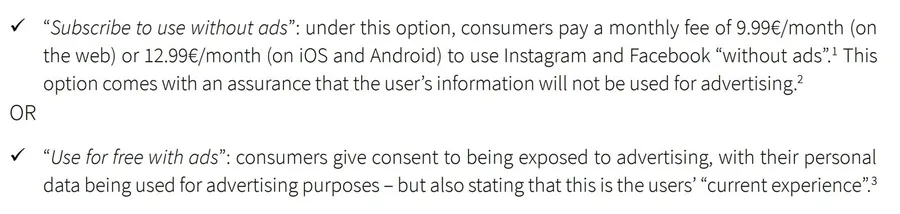
That was a wake up call. They let you choose to be the product or the customer. I read their privacy policy to understand what that meant. It took hours of reading and searching. I will go into more detail in a future post.
After that, I uninstalled Instagram. I also installed Signal and encouraged friends to switch. Their privacy policy is quite straight foreward, it states:
Privacy of user data. Signal does not sell, rent or monetize your personal data or content in any way - ever.
Further steps
At that point, I was free from Instagram doomscrolling, and almost free from short videos. Almost. I do use YouTube on my desktop computer, and since 2020 YouTube Shorts have been taking more and more space on the website. I would sometimes get lost in them for an hour instead of relaxing properly. I installed the extension Remove YouTube Shorts, which simply hides them from sight. Booyah, no more easy access to shorts !
My daily commute totals two hours. I used to organize my life during that time, and when that was done I would go on social media. I tried phone games and puzzles, but my interest never lasted long. I invested 100€ in an e-reader that fits in my pocket. It has been a good decision so far, I now spend that time reading books I enjoy.
A few months ago I got the flu and spent the day lying on the couch scrolling through Reddit. At the end of the day I felt I had wasted it, letting my brain rot and not even resting properly. I decided to uninstall Reddit the next day. At that point I had no more apps to scroll. Since then I have not felt the need to go back. I occasionally spend a few minutes on Reddit’s website when I am waiting for something without my e-reader available.
There are a few more distractions I try to remove. One is email spam. I unsubscribe from every newsletter. I repeat this every few years to make sure I am only bothered for a reason. Another is phone calls. France has a service called Bloctel which helps with cold calls. On top of that, I use a French app called Orange Phone. I gave it access to incoming numbers, and it blocks unwanted calls reported by users. I have had good results with it.
So what’s next ? I still use messaging apps daily to communicate with friends and I enjoy doing so. One thing still bothers me, the disruptiveness of notifications. If my phone is beside me and I see it light up, my brain pauses and shifts focus. Even though I keep it in silent mode most of the time, seeing the screen is enough to interrupt my train of thought. The solution is simple. I need to keep my phone away more often and pick it up only when I intend to.
Final thoughts
Time is one of the only finite resource you possess, you should use it to do things that make you happy and/or proud. I hope reading this helped questioning your own usage of social media.